ENGINEERING STUDIES / 02 — EQUITYGUARD
EquityGuard / Independent project
An agent
with tools.
And boundaries.
I built a full-stack financial risk application around an AI agent. The interesting part is how the interface, APIs and tools give that agent somewhere useful to work.
A whole application around it.
- My contribution
- Independent full-stack development
- Application
- React + FastAPI
- Agent
- Custom Python loop · Claude API
- Verification
- 23 automated tests · GitHub Actions
01 / THE QUESTION
What sits between a question
and a useful answer?
Price history, momentum indicators, news and company documents each tell part of a story. EquityGuard brings those inputs into a tool-driven analysis workflow.
I developed the React interface, FastAPI service, tool integrations and agent orchestration as one application. It explores financial risk analysis; it does not establish predictive accuracy or provide professional financial advice.
A real interface.
A defined request.
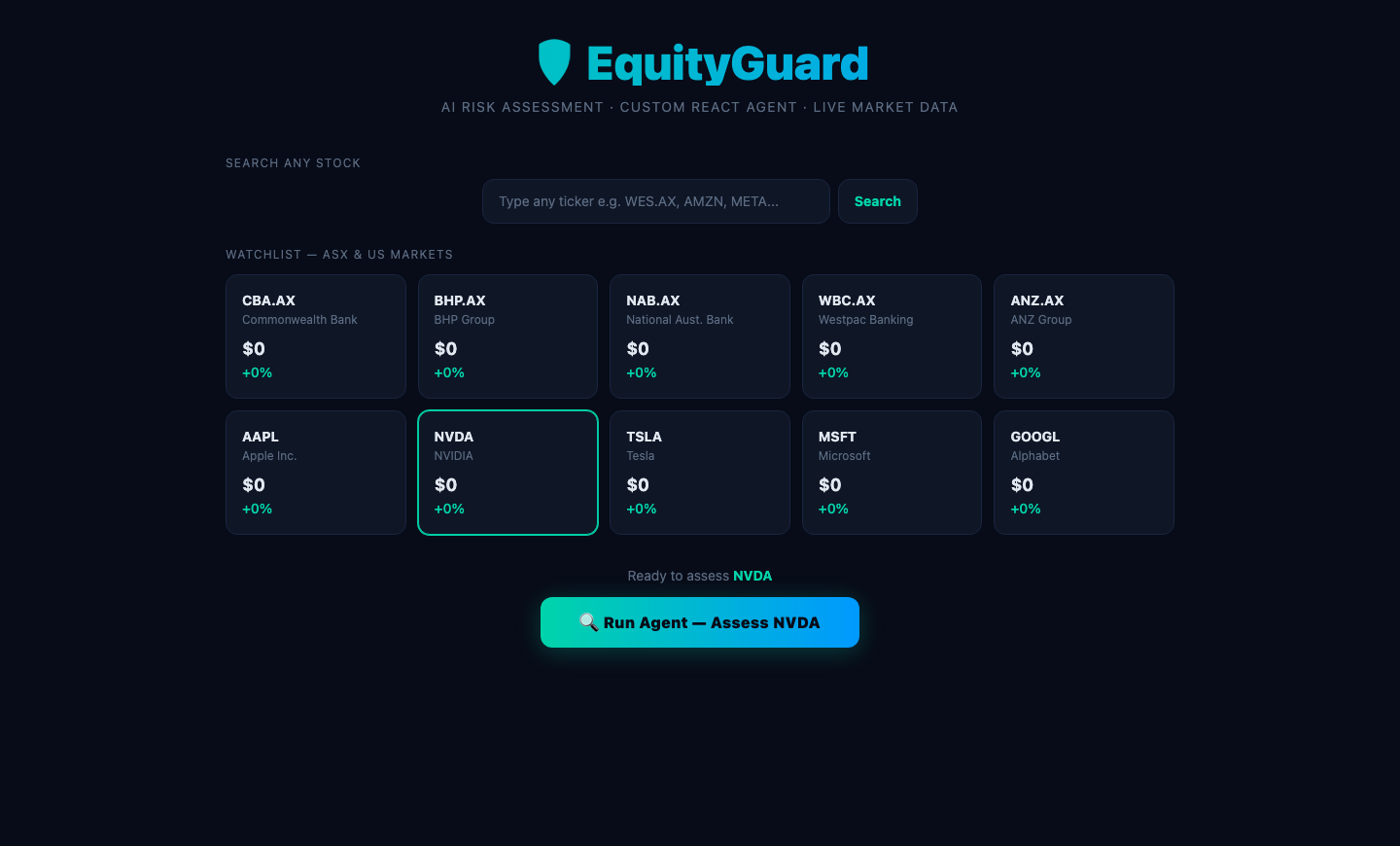
A watchlist and ticker search provide the entry point. React handles selection, loading and errors, then presents the API’s result.
02 / BEYOND THE CHATBOX
The model is one part
of the application.
Each layer owns a different responsibility. The browser makes a request; Python orchestrates the work; tool functions fetch or calculate context.
Useful boundaries
are software, too.
SOURCE-GROUNDED / NOT A DEPLOYMENT MAP
- 01
React Interaction
Selection and ticker search →
POST /analyse. Non-success responses become visible errors. The results view reads the score, explanation and tools used. - 02
FastAPI Application boundary
RiskRequestaccepts a ticker and optional query. The service normalises the ticker, applies the advice phrase filter, runs the agent and returns aRiskResponse. - 03
Python agent Orchestration
Direct Anthropic SDK calls with six JSON input schemas. A named registry dispatches tool calls and serialises returned dictionaries for the next model call.
- 04
Tools & sources Context
yfinance data, deterministic indicators, local ticker-matched files and a separate vector-retrieval path. Their outputs become context, not verified conclusions.
ticker · risk_score? · risk_label · explanation · tools_calledThe API also serialises trace metadata. This case study focuses on observable tool contracts and does not reproduce private model reasoning.
03 / INSIDE THE AGENT
A loop, with an exit.
ReAct-style orchestration, implemented directly in Python. The reviewed loop is not built on LangChain.
- 01
Receive
FastAPI trims and uppercases the ticker, builds a query and checks advice-request phrases.
- 02
Ask
Python sends the request, conversation and six tool schemas directly to the Claude API.
- 03
Dispatch
Named tool-use blocks are looked up in the registry. Returned dictionaries become JSON tool results.
- 04
Continue or stop
Tool results return to the model. An end_turn response finishes; the loop allows up to six iterations.
- 05
Respond
The API extracts a score from text, assigns a label and returns a RiskResponse for the React results view.
Tool use returns to the model. The path depends on returned tool-use blocks; this drawing describes the source control flow, not a recorded execution.
Stopping is explicit. Other stop reasons break the loop. Exhaustion returns “Agent reached maximum iterations.” A loop limit does not guarantee successful analysis.
04 / TOOL INSPECTOR
Six tools.
Different responsibilities.
A tool name can hide a lot. Select one to see what it accepts, what it returns and where its responsibility ends.
01 / Price & volatility
External data + calculation
Price & volatility
get_price_dataEstablish a market-data baseline before interpreting risk.
- Input
ticker: string (required)- Returns
ticker, current_price, previous_close, day_change_pct, volume, avg_volume_10d, beta, volatility_30d_annualised_pct, 52w_high, 52w_low- Boundary
- Fetches 30 days of history through yfinance. Annualises daily-return volatility using √252. Empty history or an exception returns an error dictionary; some missing fields use defaults.
- Test evidence
- The inspected suite does not mock or exercise this external data path.
02 / Technical signals
Calculation over external data
Technical signals
get_technical_signalsTurn price history into explicit momentum indicators.
- Input
ticker: string (required)- Returns
ticker, rsi_14, rsi_signal, macd_signal, bollinger_position_pct, bollinger_signal- Boundary
- Fetches three months of history and requires at least 30 rows. Computes 14-period RSI, 12/26/9 MACD and 20-period Bollinger position. Empty or short history returns an error.
- Test evidence
- Seven tests check RSI and Bollinger examples using helpers defined inside the test file. They do not invoke this production tool or test MACD.
03 / News context
External retrieval
News context
get_news_sentimentBring recent headlines into the model’s analysis context.
- Input
ticker: string (required) · company_name: string (optional)- Returns
ticker, headline_count, headlines[{title, published, summary}]- Boundary
- Returns up to eight yfinance news items with summaries truncated to 200 characters. The optional company name is unused. Despite its name, this tool does not compute a numerical sentiment score.
- Test evidence
- The inspected suite does not test the news response or provider failures.
04 / Earnings proximity
External data + date rules
Earnings proximity
get_earnings_riskDescribe proximity to an earnings event using deterministic thresholds.
- Input
ticker: string (required)- Returns
ticker, next_earnings_date, days_to_earnings, earnings_risk- Boundary
- Reads the first calendar value and classifies dates at 7, 21 and 42 days. Missing or unexpected calendar data yields “unknown”; it does not predict an earnings result.
- Test evidence
- Calendar formats, thresholds and error paths are not covered by the inspected tests.
05 / Company documents
Local filename lookup
Company documents
retrieve_company_docsSupply company-specific document context without a model-generated search.
- Input
ticker: string (required)- Returns
ticker, docs_found, result (combined document text)- Boundary
- Strips the exchange suffix and matches the base ticker against local filenames. A missing store or no match returns zero documents. This is distinct from semantic vector retrieval.
- Test evidence
- No document-retrieval tests are present in the inspected suite. File reading has no enclosing exception handler.
06 / Semantic knowledge
Vector retrieval · unresolved runtime
Semantic knowledge
search_company_knowledgeSearch document chunks by an embedded natural-language query.
- Input
query: string (required) · ticker: string (optional)- Returns
query, ticker, chunks_found, result (source-labelled context or a readiness message)- Boundary
- The retriever targets a ChromaDB collection with an optional ticker filter and three results by default. The reviewed file references chromadb without importing it; required retrieval packages are also absent from requirements.txt.
- Test evidence
- An isolated dependency-stub check reproduced the missing-name readiness response. No real embedding model or vector query was run.
CONTRACT SUMMARIES FROM SOURCE · NO LIVE EXECUTION · OUTPUTS ARE DICTIONARIES, NOT ENFORCED TOOL-RESPONSE MODELS
05 / DETERMINISTIC EDGES
Structure helps.
It isn’t certainty.
I put application code around model behaviour: request types, a tool registry, response shaping and visible error states. Those mechanisms have specific limits.
- Input
- Pydantic supplies request types; the API trims and uppercases the ticker. It does not validate ticker syntax or existence. The advice filter matches phrases, so it cannot establish comprehensive safety.
- Output
- The API extracts an
n/10score from model text and assigns a label. The optional integer is not range-constrained. A structured response does not guarantee a correct score. - Failure
- Most market tools return error dictionaries; unknown tool names also return an error. Argument errors and model-call failures have no general loop-level recovery. The price endpoint’s zero fallback can obscure a failed fetch.
06 / TESTING INTELLIGENT SOFTWARE
What do the tests
actually tell us?
three source files
Financial guardrails
test_guardrails.pyAdvice phrases, permitted risk questions, case handling and a non-empty refusal message.
A phrase filter, not a comprehensive safety evaluation.
Calculation examples
test_technicals.pyRSI direction and range, short history, Bollinger position type and example ranges.
Test-local helpers; no production tool or provider integration.
Evaluation definitions
test_evaluation.pyRequired case fields, unique names and refusal/non-refusal classifications.
Checks case definitions, not live agent execution or model accuracy.
23/23 passed in an isolated, network-blocked review. GitHub Actions defines separate pytest runs for these three files. That configuration is source evidence; no remote CI outcome is claimed here.
The live evaluation runner is separate and can invoke the model. It was not run. The inspected tests do not exercise FastAPI, provider integrations, retrieval or a complete agent loop.
07 / LOOKING BACK
The next work is
at the boundaries.
EquityGuard demonstrates the work of connecting an interface, API, model and external tools. It also makes the next engineering questions concrete.
The README still describes older keyword retrieval, while newer source includes ChromaDB ingestion and vector search. A missing import and undeclared retrieval dependencies leave that runtime unresolved. The separate filename lookup should not be mistaken for semantic retrieval.
My next priorities would be production-code calculation tests, mocked provider failures, API and tool-contract checks, tighter score validation and an operational retrieval check. Those are proposed improvements, not completed features.
React / FastAPI / Python / Claude API / yfinance / ChromaDB / Docker / GitHub Actions
ChromaDB describes the source retrieval path; a working deployment has not been verified.